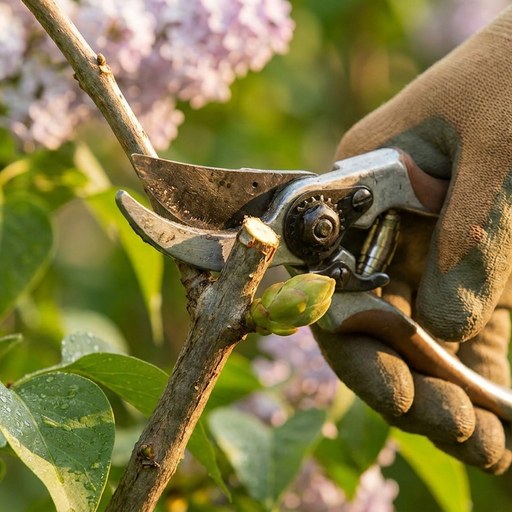
Most pruning mistakes aren’t about how you cut — they’re about when. Prune a lilac in October and the plant will be fine, but you’ll have quietly removed every flower it was going to open next May. Prune an oak in July and you can invite something far worse than a bad haircut. The good news: the timing rules are simple, and once you know which group a plant belongs to, you never have to guess again.
The one rule that covers most flowering shrubs
Shrubs that bloom in early spring — lilac, forsythia, azalea, rhododendron, and the blue-and-pink bigleaf hydrangeas — set next year’s flower buds on old wood during the previous summer. Prune them right after they finish flowering, and never later than midsummer, or you cut off the show. Shrubs that bloom in summer — panicle and smooth hydrangeas, butterfly bush, rose of Sharon, and most repeat-blooming roses — flower on new wood grown the same season, so they get cut in late winter or early spring, before growth starts.
Get the timing wrong and you almost never kill the plant — you just trade away a year of flowers. Not sure which group yours is in? Watch when it blooms: before June, prune right after flowering; after June, prune in late winter.
| Plant | Best time | Why |
|---|---|---|
| Lilac, forsythia, azalea, rhododendron | Right after spring bloom | Next year’s buds form on old wood in summer |
| Bigleaf hydrangea (blue/pink mopheads) | Just after flowering | Old wood — fall or spring cuts remove blooms |
| Panicle & smooth hydrangea | Late winter–early spring | Blooms on new wood |
| Repeat-blooming roses | Early spring, as buds swell | Blooms on new wood |
| Fruit trees | Late winter, while dormant | Structure is visible; wounds close fast in spring |
| Oaks | Winter only | Fresh warm-season cuts attract the beetles that spread oak wilt |
| Maple, birch, walnut | Early–mid summer | Late-winter cuts “bleed” sap — harmless, but messy |
| Boxwood & yew hedges | Late spring, after the first flush | Stop shearing by late summer so regrowth hardens before frost |
What you can prune right now (and what to leave alone)
The three D’s — dead, damaged, and diseased wood — can come off any day of the year, along with suckers sprouting at the base and water sprouts shooting straight up off branches. Removing them is repair, not stimulation.
Beyond that, late summer and fall are for standing back, not major surgery. Heavy pruning now does two bad things at once: it pushes out tender new growth that the first frost will kill, and on spring bloomers it removes flower buds that have already formed. A light tidy of a hedge is fine — save the real structural work for the dormant season, when you can see the branch skeleton and the plant responds by growing exactly where you want it to.
Make cuts that heal
Use sharp bypass pruners for anything up to about the thickness of your thumb, loppers up to an inch and a half, and a pruning saw beyond that — forcing a dull or undersized tool crushes the stem instead of cutting it. Cut about a quarter inch above an outward-facing bud, angled slightly away from it: the new shoot grows outward and opens up the plant instead of crowding the center.
When removing a whole branch, cut just outside the branch collar — the slightly swollen ring where branch meets trunk — never flush with the trunk, and never leaving a long stub. The collar is where the tree seals the wound. Two more rules separate good pruning from butchery: never remove more than about a quarter of a live plant in one year, and never “top” a tree — topping triggers weak, fast regrowth that’s more dangerous than what you removed. Wipe your blades with rubbing alcohol between plants, and always after cutting anything diseased.
As an Amazon Associate, Clearly earns from qualifying purchases.
Do the deer do more pruning than you?
If a shrub keeps getting shredded no matter how well you shape it, swap it for something deer walk past. Search 500+ plants by name and see exactly how deer-resistant each one is — free.