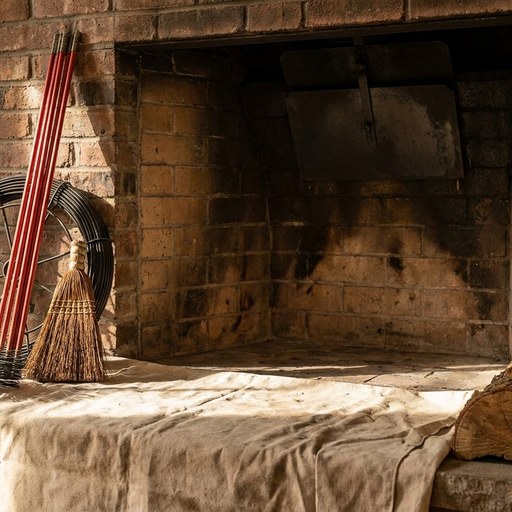
The first fire of the year is one of the nicer moments in a house. It is also the moment a summer’s worth of problems — a squirrel’s nest on the smoke shelf, a damper rusted half-shut, a quarter inch of creosote in the flue — all show up at once, with a lit fire already underneath them.
Heating equipment is one of the leading causes of home structure fires in the U.S., and fireplaces and chimneys are where a large share of those start. Almost all of it is preventable, and almost all of the prevention happens on a mild day when the fireplace is cold. Here’s the whole job.
Book the sweep now — the calendar is half the trick
The NFPA standard for chimneys (NFPA 211) is blunt about it: chimneys, fireplaces and vents should be inspected at least once a year and cleaned as needed. “As needed” has a number attached — the Chimney Safety Institute of America’s rule of thumb is that once creosote reaches about one-eighth of an inch on the flue walls, it should come out. Creosote is condensed, unburned wood smoke, and at that thickness it is fuel sitting inside a chimney that routinely runs hot enough to light it.
There are three inspection levels, and it’s worth knowing which one you’re buying:
- Level 1 — the annual standard for a fireplace you use the same way you did last year. Readily accessible parts, visual check, sweep.
- Level 2 — required when you change fuels or appliances, after a chimney fire or an earthquake, and when a home is sold. Adds a camera scan of the flue interior, plus attic and crawlspace runs.
- Level 3 — invasive; only when a Level 1 or 2 turns up a hazard that can’t be seen any other way.
Hire a CSIA-certified sweep, and hire one in September or early October. By the first genuinely cold week, the same person is booked three weeks out and charging peak-season rates, and you are the one deciding whether to risk “just one fire” while you wait. That decision is the whole reason this article is a September article.
Chimney caps and spark arrestors →
The walk-around you can do yourself first
None of this replaces the inspection, but it tells you what to point at, and it catches the things that will otherwise be discovered by smoke in your living room. Do it with a flashlight, cold fireplace, drop cloth down, and binoculars for the roof — stay off the roof.
| Where to look | What you want to see | Why it matters |
|---|---|---|
| Damper | Opens fully, closes and seals, moves without forcing | A damper rusted shut fills the room with smoke; one that won’t close sends your furnace heat up the flue all winter |
| Firebox brick and mortar | No cracked or spalling firebrick, no crumbling or missing joints | The masonry is what keeps fire away from the wood framing behind it |
| Smoke shelf and firebox floor | Empty — no twigs, leaves, nesting material or soot piles | Birds, squirrels and raccoons nest in unused flues; a blocked flue backdrafts carbon monoxide into the house |
| Flue liner (look up) | Continuous tile or metal, no gaps; no tile shards in the firebox | A cracked or missing liner lets heat and gases reach framing and neighboring flues |
| Chimney cap and screen | Cap present and secure, spark screen intact | Keeps out rain, animals and downdrafts, and keeps embers off your roof |
| Crown and flashing (binoculars) | Crown not cracked, flashing flat and sealed, bricks not flaking | Water, not fire, is what destroys most chimneys — it freezes in the masonry and takes it apart |
| Hearth extension | Intact, no cracked or missing tile, and it actually extends past the opening | Rolling logs and popping embers land there instead of on the floor |
Two things on that list are worth acting on immediately if they’re wrong. A missing chimney cap is a cheap fix that prevents an expensive one — an open flue is a rain funnel and an animal door. And a cracked or undersized hearth extension is the one item in the list that a homeowner can genuinely improve in a weekend; if you’re re-tiling the hearth or the surround, our tile calculator will give you the piece count and the waste allowance before you go to the store.
Also open the damper, put your hand near the opening, and see which way the air is moving. If cold air is pouring in, the flue is cold and the chimney will smoke when you light it — see the priming trick below. If you never use the fireplace, a closed damper plus a chimney balloon or fitted damper seal stops a surprising amount of heat loss; that’s in the same family as the rest of draft-proofing the house.
Your firewood decides how clean the chimney stays
Creosote isn’t random. It is what happens when smoke leaves the fire cooler than it should and condenses on the flue walls, and the single biggest cause of cool, smoky fires is wet wood. Freshly cut wood is roughly half water by weight; every bit of that water has to be boiled off by your fire before the wood can burn properly, which is heat going up the chimney instead of into the room, and smoke instead of flame.
The target is 20% moisture content or less. Getting there means splitting the wood, stacking it off the ground in a single row with air on both sides, and covering only the top — a tarp wrapped down the sides traps moisture and does the opposite of seasoning. Softwoods can get there in six months; oak and other dense hardwoods want a full year or more.
- Check it, don’t guess. Split a piece and press a moisture meter to the fresh inside face. The outside of a log reads dry long before the middle is.
- The no-meter version: seasoned wood is noticeably lighter, gray and checked with cracks radiating from the end grain, the bark comes loose, and two pieces knocked together clack instead of thudding dully.
- Buy early, burn late. Wood sold as “seasoned” in October frequently isn’t. If you’re buying by the cord, see how much firewood is actually in a cord so you can tell what you’re paying for.
And a short list of things that should never go in a fireplace: pressure-treated, painted or stained lumber (releases arsenic, chromium and other toxins), plywood, particleboard and pallets (glues and unknown treatments), driftwood (salt turns into corrosive acid in the flue), Christmas trees and evergreen boughs (resin, flare-ups and heavy creosote), cardboard and wrapping paper (flaming fragments carried up the flue onto the roof), and any accelerant at all.
Lighting it, running it, and cleaning up after it
Open the damper all the way before you strike a match, and check by looking up, not by feel. If cold air is falling down the flue, prime it first: roll a sheet of newspaper into a torch, light it, and hold it up in the throat of the fireplace for thirty seconds or so until you feel the draft reverse. In a tight, well-sealed house, cracking a nearby window an inch gives the fire the make-up air it needs to draw.
Build it top-down. Largest splits on the bottom, medium above them, kindling across that, tinder on top. It feels backwards and it burns far better: the fire lights the flue gently from above, reaches temperature faster, and produces a fraction of the smoke — which is to say a fraction of the creosote.
- Small, hot fires beat big, smoldering ones. Damping a fire down to make it last is exactly the condition that coats a flue.
- Never leave an open fireplace burning overnight or unattended, and put the screen or doors closed before you leave the room.
- Three feet of clearance around the hearth — stockings, garland, kindling baskets, the dog bed and the rug all count.
- Leave about an inch of ash in the firebox as an insulating bed; it helps the next fire. Shovel out the rest when it builds past that.
Ashes are the part people get casually wrong. Embers stay hot enough to start a fire for three or four days, buried in ash that looks completely dead. Shovel them into a metal container with a lid — never a paper bag, a shop vac, a cardboard box or a plastic bin — set it outside on concrete or bare dirt well away from the house, deck and siding, and leave it there for several days before the ashes go anywhere else.
Last, the backstop: test every smoke alarm in the house, and make sure you have carbon monoxide alarms on every level and near sleeping areas. A blocked or leaking flue doesn’t announce itself with smoke — CO is the thing that gets people, and the alarm is the only way you’ll know. It’s a ten-minute check, and it belongs in the same afternoon as everything else here.
Do all of this in one mild September afternoon and the first fire of the season is just a nice evening — which is the entire point of it.
As an Amazon Associate, Clearly earns from qualifying purchases.
Redoing the hearth or the fireplace surround?
Get the tile count, the layout and the waste allowance before you buy — free, no signup.