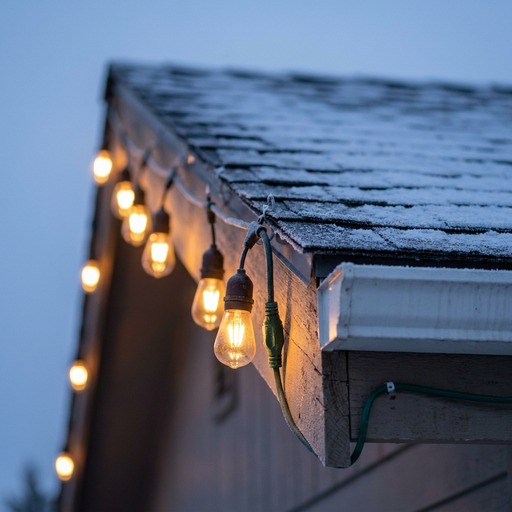
Holiday lights are one of the few home projects where the dangerous part isn’t obvious. The decorating is the fun bit; the risk lives in the outlet, the extension cord and the ladder. Fire investigators consistently trace a large share of holiday-season home fires back to electrical distribution and lighting equipment — cords, plugs and light strings — rather than to anything as cinematic as a candle.
September is a strange time to think about it and exactly the right time to buy. The good outdoor-rated cords, the timers and the clips sell out in December and get marked up in November, and more to the point: every decision that makes a light display safe gets made on the ground, before the first strand goes up. So here is the whole thing, in the order you’ll actually need it.
Do the circuit math before you buy another box
A standard 15-amp household circuit can carry 1,800 watts, but the working rule for anything running for hours is 80% of that — about 1,440 watts. A 20-amp circuit gives you roughly 1,920 usable watts. That budget is shared by everything else on the circuit, which is why the garage freezer or a space heater on the same run is what actually trips the breaker on December 1st.
| String type | Typical draw | On a 1,440 W budget |
|---|---|---|
| C9 incandescent, 25 bulbs (7 W each) | ~175 W per string | About 8 strings |
| C7 incandescent, 25 bulbs (5 W each) | ~125 W per string | About 11 strings |
| Mini incandescent, 100 bulbs | ~40 W per string | 30+ strings |
| LED C9, 25 bulbs | ~2–3 W per string | Effectively unlimited — the tag is your limit, not the breaker |
| LED mini, 100 bulbs | ~5 W per string | Effectively unlimited |
| Inflatable yard decoration (blower runs constantly) | 30–150 W each | Check the label — these add up fast |
These are typical figures; the label on your box wins. And there is a second, stricter limit that most people never read: the tag on the string tells you the maximum number of strings you may connect end-to-end. It is usually 3 to 5 for incandescent and 20 or more for LED. That number is a wire-gauge limit — the first plug carries the current for everything downstream of it — so it is not a suggestion, and exceeding it overheats the plug long before it bothers the breaker.
Two more non-negotiables. Every outdoor receptacle feeding lights must be GFCI-protected. If your exterior outlet doesn’t have the test/reset buttons, a plug-in GFCI adapter costs a few dollars and does the job; press the test button before the season starts and once a month while they’re up. And never mix incandescent and LED strings end-to-end — the LED strings aren’t built to pass the incandescent current through.
Cords and plugs: the part that actually starts fires
An indoor extension cord used outside is the single most common mistake of the season. Outdoor cords have thicker, UV- and moisture-resistant jackets and are marked with a W on the jacket, usually alongside a type code like SJTW. If there’s no W, it stays inside.
- Match the gauge to the run. 16 AWG is fine for a light load up to about 50 feet; 14 AWG for up to 100 feet; 12 AWG for long runs or anything heavy. A long, thin cord drops voltage and turns the difference into heat.
- Give every connection a drip loop. Let the cord sag below the plug so water runs down and drips off instead of tracking into the connection. Point connections downward, and keep them off the ground and out of puddles and snow piles.
- Cover the joints. A weatherproof cord-connector cover for the plug junctions, and an in-use “bubble” cover on the outlet itself, are cheap and eliminate the wettest failure point.
- Never staple or nail through a cord, and never run one under a rug, a doormat or a door that pinches it. Insulated cable staples or plastic clips only.
- No power strips or surge protectors outdoors. They aren’t rated for wet locations, and daisy-chaining them is how you defeat the wattage limits you just calculated.
- A cord that feels warm is overloaded. Unplug it and split the load; warm is the warning that comes before hot.
Outdoor-rated extension cords →
Before anything goes up, lay last year’s strings out on the garage floor and look at them in good light. Cracked or brittle insulation, a blackened or loose plug, wobbly sockets, or a bare socket with a missing bulb all mean that string is done — an empty socket is an open path for arcing and shock. Check for a UL or ETL listing mark and confirm the string is rated for outdoor use; many indoor-only sets look identical. Then plug each one in on the ground to find the dead section before it’s twenty feet up.
Hanging them without damaging the house — or falling off it
Use plastic light clips made for gutters, shingles and ridges. They cost a few cents each, they hold better than you expect, and they don’t put a metal fastener through the cord jacket. Staples and roofing nails driven through a strand nick the insulation, and that nick sits there in the weather all season.
- Measure the run first. Pace off the roofline or railing, add 10–15%, and buy accordingly. Splicing on one more string at the far end is exactly how people end up over the end-to-end limit.
- Fiberglass ladder, not aluminum, anywhere near electrical work. Set it at the 4:1 angle — the base one foot out from the wall for every four feet of height — on level, solid ground, and let it extend about three feet past the roof edge.
- Three points of contact, and never the top two rungs. Move the ladder rather than leaning; overreaching is the mechanism in most ladder falls. Have someone else in the house who knows you’re up there.
- Stay away from the service drop — the overhead wires running from the utility pole to your house. Never let a ladder, a pole, a hook or a light string come near them. Those conductors are utility-owned and unforgiving; if the display requires working around them, redesign the display.
- Work dry and above freezing. Frost on shingles behaves like grease, and a cold cord goes stiff and cracks when you bend it.
Gutter and shingle light clips →
The single change that removes the most risk is a design decision, not a product: light the things you can reach. Shrubs, porch railings, door frames, a wrapped tree trunk, a lit wreath and a couple of yard pieces read beautifully from the street and never involve a roof. Rooflines are the highest-effort, highest-risk part of any display, and from a car at 25 mph they are not what people notice.
Set a timer — the safest $15 in the box
Almost every piece of holiday-lighting guidance ends with “don’t leave them on overnight or when you’re away,” and almost nobody manages it by memory. A timer does it for you, cuts the run hours roughly in half, and takes the lights off the circuit while everyone is asleep.
- Buy one rated for outdoor/wet locations with a gasketed housing, and check that its wattage and amperage rating comfortably exceeds the load you calculated above.
- A photocell “dusk plus six hours” setting is the sweet spot — on automatically at dark, off around 11 p.m., no clock to reset when the power blips or the time changes.
- Smart plugs work if, and only if, they are specifically outdoor/wet-location rated and within their wattage limit. An indoor smart plug sheltered in a plastic tub is not an outdoor smart plug.
- Unplug entirely before you travel. A timer is for a normal week at home, not for a house standing empty for ten days.
- Take them down when the season ends. Holiday lighting is designed and listed as temporary — roughly 90 days is the standard figure. A year of UV, freeze-thaw and ice does real damage to jackets and sockets, and that damage is invisible until the following December.
Outdoor timers with photocells →
When it’s over, wind each string onto a reel or a rectangle of cardboard rather than coiling it around your arm, label it with where it went, and store it dry and indoors. Cords put away damp corrode at the sockets over the summer, and the whole point of doing this carefully in September is not having to do it twice.
As an Amazon Associate, Clearly earns from qualifying purchases.
Still shopping for the season?
Our 2026 roundup of practical, DIY-minded gifts — the useful end of the gift aisle, free to browse.