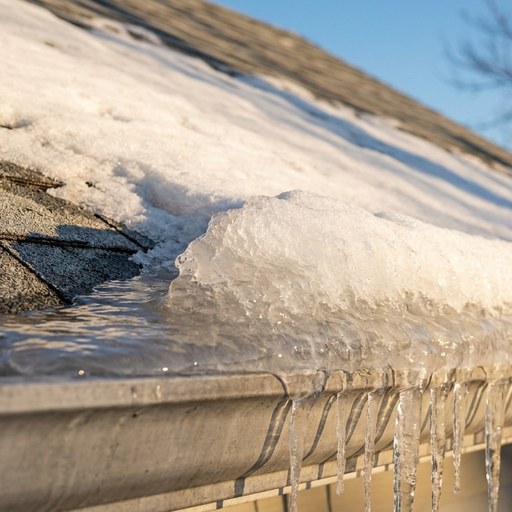
An ice dam looks like a weather problem. It isn’t — it’s a heat problem wearing a winter coat. Snow melts on the warm upper part of your roof, the water runs down to the cold overhang, and it refreezes there into a ridge. Every thaw adds to it, and eventually meltwater pools behind that ridge and works its way backward under the shingles into your sheathing, your insulation and your ceiling. The repair bill lands in February. The actual fix happens in September.
Why the ice forms exactly where it does
Heat escaping from your living space warms the underside of the roof deck. That stretch of roof runs above freezing even when the air outside doesn’t, so the snow sitting on it slowly melts. The water runs down until it reaches the eave — the overhang past your exterior wall, which has cold outside air on both sides — and there it freezes solid. Repeat that for a week and you get a dam.
The dam itself isn’t what wrecks your house; the water trapped behind it is. Shingles are designed to shed water running downhill, not to hold back standing water, so anything ponded above the dam finds the laps and runs uphill under them. Signs to look for: a thick band of icicles at the gutter line, a solid ridge of ice at the roof edge, damp or matted attic insulation, and brown stains on the ceiling where an exterior wall meets it.
The goal is a cold roof — a deck that stays close to the outdoor temperature, so snow just sits there until it sublimates or slides. Well-sealed, well-insulated, well-ventilated attics almost never grow dams, even in the same storm that hammers the house next door.
The real fix happens before the snow: seal, insulate, ventilate — in that order
Heat rides on moving air, so air sealing comes first. Insulation piled on top of unsealed gaps just filters the air on its way through. Get into the attic on a cool day with a headlamp and look for dirty, dark streaks in the insulation — that discoloration is dust filtered out of escaping household air, and it marks your leaks for you.
| Where the heat gets out | What to do about it |
|---|---|
| Attic hatch or pull-down stairs | Weatherstrip the opening and add an insulated cover box — usually the single biggest leak |
| Top plates of interior walls | Caulk or foam the gap where drywall meets the framing |
| Plumbing and wiring penetrations | A bead of canned foam around each pipe and cable |
| Chimney or flue chase | Sheet-metal collar plus high-temperature fire-rated sealant — never spray foam against a flue |
| Recessed can lights | Swap to airtight IC-rated fixtures before you bury them in insulation |
| Bath fans and dryer vents | Duct them all the way outdoors — never into the attic |
| Eaves and soffits | Baffles at each rafter bay so insulation can’t choke the intake vents |
Attic hatch insulation covers →
Once it’s sealed, insulate. Most cold-climate attics want somewhere around R-49 to R-60 — roughly 16 to 20 inches of blown fiberglass or cellulose — and the coverage has to be even, right out over the top plate of the exterior wall where dams start. Then ventilate: continuous soffit intake at the bottom, ridge or roof exhaust at the top, so outdoor air flushes whatever heat is left and keeps the deck cold. Baffles at the eaves are what keep blown insulation from burying the soffit vents and killing the intake.
None of this is exotic, and none of it is wasted money even in a mild winter — it’s the same work that cuts your heating bill and stops the upstairs from being ten degrees colder than the downstairs.
What to do when a dam has already formed
Once ice is on the roof, your job is getting the water out, not getting the ice off.
- Rake the eaves from the ground. After each storm, pull the first three or four feet of snow off the roof edge with a long-handled roof rake. No snow above the eave means no meltwater to trap. Stay on the ground — never a ladder, never the roof, not in ice.
- Melt a channel, don’t break one. Fill a nylon stocking or long sock with calcium chloride ice melt and lay it across the dam, perpendicular to the eave, so it melts a drainage channel through the ice. Use calcium chloride, not rock salt — sodium chloride corrodes gutters, flashing and fasteners and kills whatever it drips onto. (It’s the same reason we tell you to keep rock salt off your concrete.)
- Never chip, chisel or hammer the ice, and never go after it with a torch or open flame. Every winter, roofs catch fire this way. Hacking at ice takes the shingles with it.
- If water is already inside, and the ceiling drywall is bulging with trapped water, put a bucket underneath and poke a small hole at the low point of the bulge to drain it. Relieving it saves the whole ceiling from coming down at once.
- Heat cables are a bandage, not a cure. They can hold a drainage channel open on a chronically bad roof, but they run up the electric bill every hour they’re on and they do nothing about the heat loss causing the problem.
- Call a pro for a big or recurring dam, and make sure they use low-pressure steam. A pressure washer strips the granules off your shingles and shortens the roof’s life.
Gutters don’t cause ice dams — but clogged ones make it worse
This one gets blamed a lot and it’s mostly a myth: a dam forms at the roof edge whether gutters are hanging there or not, and taking your gutters down won’t save you. What a clogged gutter does do is make the situation worse. A trough packed with wet leaves freezes into a solid block of ice that anchors the dam and holds meltwater right against the eave, and a frozen downspout gives the water nowhere to go even after the roof starts draining.
So clean them out after the leaves finish dropping and check them again before the first hard freeze, and make sure downspouts actually discharge away from the foundation. While you’re in the attic, look toward the eaves in daylight — if you can see light coming through the soffit vents, your intake is open. If you can’t, insulation is blocking it, and that’s a dam waiting to happen.
As an Amazon Associate, Clearly earns from qualifying purchases.
Already patching a stained ceiling?
If a dam got inside before you got to it, work out exactly how much drywall, joint compound and tape the repair needs — free, no sign-up.