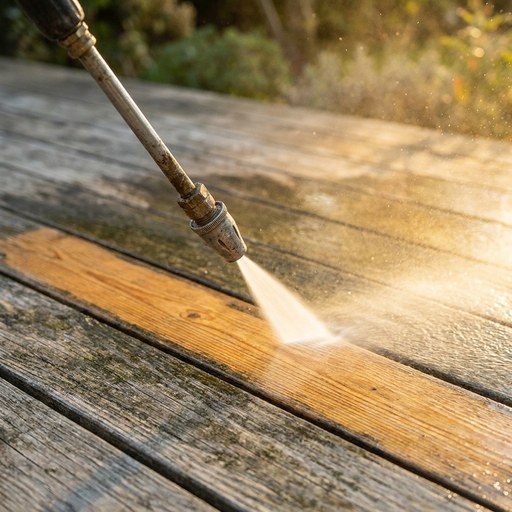
A pressure washer is the fastest way to make a house look ten years younger — and the fastest way to carve permanent stripes into a deck, drive water behind your siding, or blow the mortar out of a brick joint. Almost every bad result comes from the same two mistakes: too much pressure, and the nozzle held too close. Here’s how to get the clean without the damage.
Match the pressure to the surface
Machines are rated in PSI (force) and GPM (rinsing volume). Most electric units run about 1,300–2,000 PSI, which handles nearly every household job. Gas units hit 2,500–4,000 PSI — great for concrete, dangerous for almost everything else.
Rough targets: vinyl and painted siding, 1,200–1,500 PSI. Wood decks and fences, 500–1,200 PSI (softwoods like cedar and pine at the low end). Concrete driveways and patios, 2,500–3,000 PSI. If your machine only has one setting, back the wand away from the surface — distance is a pressure control. Always test on a hidden corner first.
Use the right nozzle — and never the red one
Nozzles are color-coded by spray angle: red 0°, yellow 15°, green 25°, white 40°, and black 65° (low pressure, for applying soap). The red 0° tip concentrates all the force into a pencil-thin jet — it etches concrete, shreds wood, and can cause a serious injection injury through skin. There is almost no home job that needs it. Leave it in the box.
Start with the white 40° tip for siding and the green 25° for wood and concrete. Hold the wand 12–18 inches back, keep it moving in long overlapping passes, and on wood always follow the grain — stopping in one spot for even a second leaves a permanent fuzzy scar. On a driveway or patio, a rotating surface-cleaner attachment gives a far more even result than waving a wand back and forth, and it does it in a fraction of the time.
Let the detergent do the work
Pressure blasts dirt off. It does not kill the black and green stuff on your north-facing siding — that’s algae and mildew, and it grows straight back unless you use a cleaner. Apply a proper house wash or deck cleaner with the black soap nozzle, let it dwell 5–10 minutes (never let it dry on the surface — work in the shade and mist it if you need to), then rinse.
Two rules that save you a weekend of streaks: apply soap from the bottom up, rinse from the top down, and on lap siding never aim upward. Spraying up under the laps drives water behind the siding and into the wall, where it has no way out. Wet nearby plants before you start and rinse them after, and use a cleaner rated for your surface rather than straight bleach, which is hard on plants, metal, and finishes.
Five things you should never pressure wash
Asphalt roof shingles. The spray strips the protective granules and forces water under the shingles. Roofs get soft-washed with chemicals at garden-hose pressure, or they get left alone.
Old mortar and soft brick. Anything crumbly will simply be washed out of the joint.
Paint you intend to keep — and anything painted before 1978. Pre-1978 paint may contain lead, and blasting it spreads contaminated chips and dust across your yard.
Windows, light fixtures, outlets, and A/C condenser fins. High pressure breaks seals, forces water into electrical boxes, and flattens the delicate fins on your condenser.
Anything you’re standing on a ladder to reach. The wand kicks back hard. Use an extension wand from the ground, and wear eye protection and closed-toe shoes — never sandals, and never point the wand at a person or pet.
As an Amazon Associate, Clearly earns from qualifying purchases.
Boards too far gone to save?
If the wash reveals rot instead of good wood, it’s time to replace some boards. The free deck calculator works out how many deck boards, joists, and fasteners you need — so you order once.