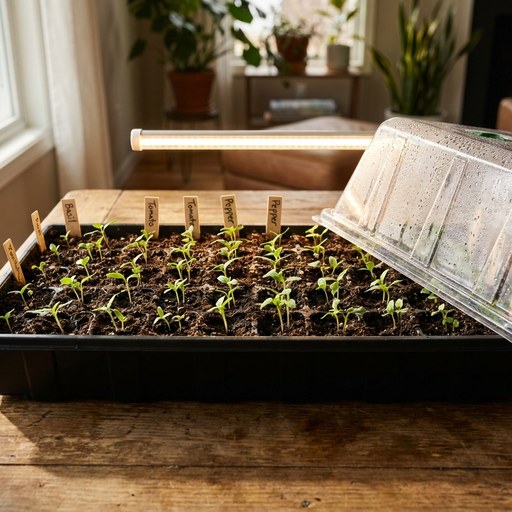
Seed starting has a reputation for being fussy, and it mostly isn’t. Nearly every failure traces back to one of four things: not enough light, the wrong soil, water in the wrong place, or moving plants outside too fast. Fix those and a $3 packet of seeds turns into forty plants that would have cost you $150 at the garden center.
You do not have to wait for February to try it, either. Late summer is the quiet second season for indoor starting — it’s still too hot outside for lettuce, spinach, kale, broccoli and cabbage to germinate well in the ground, but a tray indoors gives them a head start for a fall harvest. It’s also a low-stakes rehearsal: get your setup working now and you’re not learning it under pressure in the spring.
Leggy seedlings are a light problem, not a luck problem
If your seedlings come up looking like pale bean sprouts — long, floppy stems and a couple of sad leaves at the top — they’re stretching toward a light source that isn’t strong enough. That stretch is permanent. A stretched seedling never bulks back up, it just gets tippier.
A sunny windowsill is not enough light, and this is the single most common mistake. Even a south-facing window in March delivers a fraction of what an open sky gives a plant, and it comes from one side, which is why windowsill seedlings lean. Seedlings want 14 to 16 hours a day of bright light from directly overhead.
An inexpensive LED shop light or grow-light bar solves it. The details that matter more than the brand:
- Hang it 2 to 4 inches above the leaves and raise it as the seedlings grow. Closer than you think is correct.
- Put it on a plug-in timer for 14–16 hours. Plants need the dark period too, and you will absolutely forget to turn it off.
- Full-spectrum or plain daylight-white is fine. You don’t need the purple blurple panels for vegetable seedlings.
- Add a small fan on low, a few hours a day. The air movement thickens stems and dramatically cuts down on damping-off, the fungal collapse that snaps seedlings off at the soil line overnight.
LED grow lights for seedlings →
Count backward from your frost date
Timing is the other half of the job, and it works in reverse: look up your average last spring frost date, then count backward by the number of weeks each crop needs. Start too early and you end up with a root-bound tomato in a tiny cell in April with six weeks still to go. Most people start tomatoes about a month too soon.
| Crop | Start indoors | Move outside |
|---|---|---|
| Onions, leeks | 10–12 weeks before last frost | 2–4 weeks before last frost — they’re cold-tough |
| Peppers, eggplant | 8–10 weeks before | 2–3 weeks after last frost, once soil hits 65°F |
| Tomatoes | 6–8 weeks before | After last frost, nights above 50°F |
| Broccoli, cabbage, kale | 6–8 weeks before (or mid–late summer for a fall crop) | 2–4 weeks before last frost; fall crop goes out in early fall |
| Lettuce, spinach, chard | 4–6 weeks before | 3–4 weeks before last frost |
| Basil | 6 weeks before | Well after frost — cold turns it black |
| Cucumbers, squash, melons | 3–4 weeks before, in bigger cells | After frost. They resent transplanting, so keep the window short |
| Zinnias, marigolds, cosmos | 4–6 weeks before | After last frost |
Some things simply don’t want to be started indoors at all. Beans, peas, corn, carrots, beets, radishes and turnips either grow so fast that transplanting gains you nothing, or they hate having their roots disturbed. Sow those straight into the ground and save your tray space.
The mix, the containers, and watering from the bottom
Use seed-starting mix, not garden soil and not potting soil. Garden soil compacts into a brick in a small cell and brings fungus and weed seed indoors with it. Standard potting soil is too coarse and too rich — seeds carry their own food for the first week or two and don’t want fertilizer yet. Seed-starting mix is fine-textured and sterile, which is exactly the point. Wet it in a bucket until it’s the dampness of a wrung-out sponge before you fill cells; dry mix repels water and floats seeds around.
- Depth: plant a seed about twice as deep as it is wide. Tiny seeds like lettuce and snapdragons need light to germinate — press them onto the surface and don’t bury them.
- Two seeds per cell, then snip the weaker one off at the soil line with scissors once both are up. Pulling it tears the roots of the keeper.
- Label as you go. Every seedling looks identical for the first two weeks. Every single year, somebody plants a row of mystery brassicas.
- Dome on until they sprout, then off. The clear lid holds humidity for germination. Leave it on afterward and you’ve built a petri dish for damping-off.
- Water from below. Set the tray in an inch of water for 10–20 minutes and let the mix wick it up, then pour off the extra. Never leave cells sitting in standing water. Bottom watering keeps leaves dry and pulls roots downward.
- Start feeding at the second set of leaves — the true leaves, not the first rounded pair — with a half-strength liquid fertilizer every week or two.
Seed-starting trays with domes →
A heat mat is worth it for peppers, eggplant, tomatoes and basil, which want soil around 75–80°F to germinate and will sulk for weeks in a 65°F room. Take the tray off the mat the moment the seedlings emerge — from then on, cooler and brighter grows a sturdier plant. Lettuce, brassicas and onions don’t need the mat at all; they germinate fine at room temperature.
Hardening off: the week people skip exactly once
Indoor seedlings have never felt real sun, wind, or a cold night. Take them from a windowsill straight to a garden bed and they will scorch white and collapse in an afternoon, which is a brutal way to lose eight weeks of work. The transition needs about a week:
- Days 1–2: one to two hours outside in full shade, sheltered from wind. Bring them in.
- Days 3–4: three to four hours, with an hour of morning sun.
- Days 5–6: most of the day, working up to several hours of direct sun.
- Day 7: leave them out overnight, if no frost is forecast and nights are above about 50°F.
Water more often during this week — wind and sun dry small cells out startlingly fast. Then transplant on an overcast day or in the evening rather than into blazing midday sun, water them in immediately, and expect a few days of sulking before they take off. That pause is normal.
As an Amazon Associate, Clearly earns from qualifying purchases.
Know where they’re going before they’re ready
Building or filling a raised bed for these seedlings? Work out the soil volume and how many plants actually fit — free, no sign-up.